We focus on various types of insurance scenarios, providing customized risk reduction solutions. With professional risk control capabilities, we achieve proactive risk prevention and closed-loop management, helping clients build a solid safety barrier and achieve win-win outcomes for all parties.
▶ Engineering Quality – Full-cycle protection of construction quality, escorting the entire process from construction to operation and maintenance
• Construction Quality Defects Insurance (IDI) Whole-Process Risk Management
Covers full-process risk control of design review, construction inspection, and final completion inspection, systematically identifies quality hazards and issues professional evaluation reports, helping to improve project quality and avoid later rework costs. At the same time, it safeguards the rights of owners, assists insurance institutions in reducing compensation risks, and achieves stable operations.
• Construction All-Risk Risk Reduction Services
Throughout the entire construction process, focus on inspecting construction safety, project quality, and natural disaster risks, provide targeted rectification suggestions and prevention plans, reduce the rate of construction accidents and property losses, and assist both construction units and insurance institutions in minimizing losses.
• Urban Housing Safety Inspection (Existing Buildings)
Using a 'manual inspection and intelligent monitoring' dual mode, conduct structural safety inspections and dynamic monitoring of insured existing buildings, promptly identify hidden risks, provide reinforcement suggestions, protect residents' safety, and reduce insurance claim risks.
• Green Building Performance Risk Control Services
Participate throughout the entire process of green building performance management, conduct risk assessment and optimization guidance for energy-saving indicators, material processes, etc., ensure green performance standards are met, prevent 'pseudo-green buildings,' help construction units fulfill commitments, enhance project premium, and reduce performance-related insurance claims risk.
▶ Production Safety and Responsibility — Focusing on Personnel Safety and Preventing Liability Risks
• Accident Responsibility Insurance Accident Prevention Services
Providing systematic services such as safety training, hidden danger inspections, and standardization construction throughout all aspects of enterprise production and operation, reducing the rate of work-related injuries from the source, protecting employee safety and occupational health, helping enterprises avoid employer liability risks and production stoppage losses, and assisting insurance institutions in achieving risk reduction and improving business sustainability.
• Campus Liability Insurance Risk Control
Carry out special inspections of key risk points such as school building safety, fire safety, and activity safety, provide rectification guidance and safety management optimization plans, strengthen campus safety defenses, reduce student accidents, safeguard students' physical and mental health, help schools avoid liability risks, and reduce complaints and potential public opinion issues.
• Elderly care institution liability insurance risk control
Based on the movement characteristics of the elderly, provide specialized protection plans for key scenarios such as facility safety, nursing services, and fire safety, reducing the risk of accidental injuries, standardizing institutional operation management, ensuring the safety of the elderly and the peace of mind of their families, while also helping elderly care institutions avoid operational liability risks and improve their reputation and compliance level.
▶ Property rights — Closed-loop protection before and during, safeguarding asset value
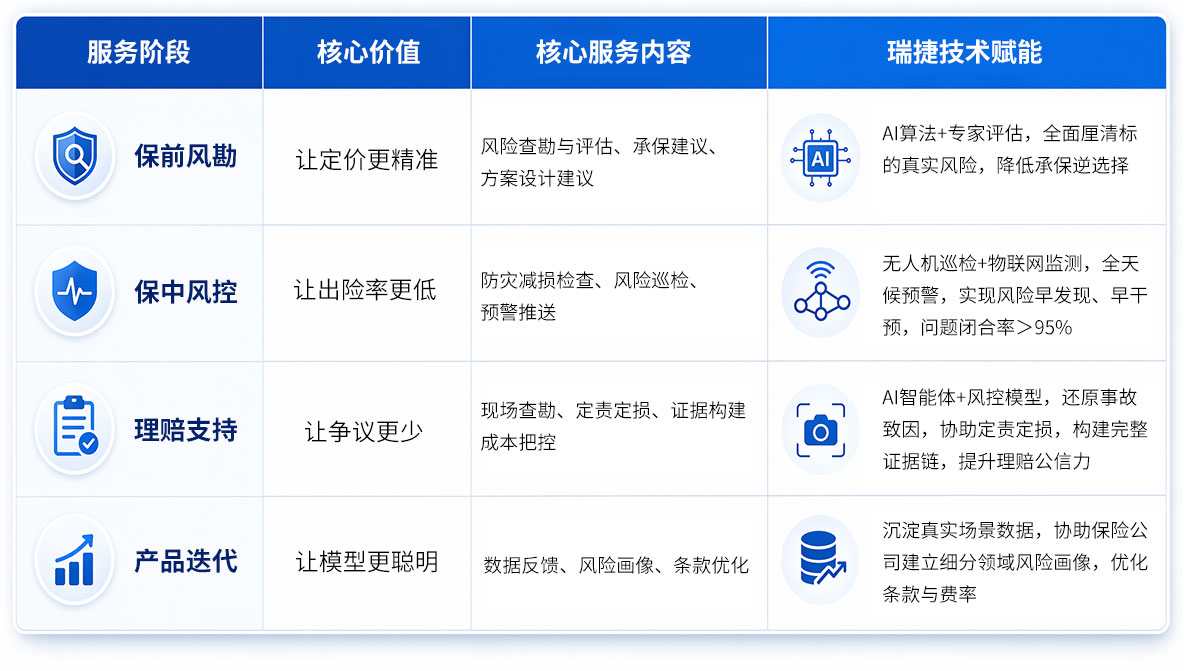
• Full-cycle risk investigation of corporate property insurance
Build a full-process closed-loop risk control for pre-underwriting, underwriting, and claims: conduct on-site surveys and evaluations before underwriting to provide data support for precise underwriting and pricing; identify major hidden risks and provide disaster prevention and loss mitigation advice during underwriting; participate in technical appraisal and loss assessment during the claims stage to help control claims risk and costs. Reduce the likelihood of corporate property accidents, limit the scale of losses, and help insurance institutions lower claim ratios and achieve stable operation.
• Comprehensive Insurance Risk Control for Rural Roads
Carry out special inspections on common issues such as rural road maintenance, slope drainage, and road surface damage, provide professional maintenance advice and hidden danger rectification plans, improve road traffic conditions, reduce the risk of damage and accidents, ensure the travel safety of villagers, help insurance companies reduce claims, and support the improvement of rural infrastructure quality.
▶ Agricultural Risk Category — Safeguarding Farmland Construction, Ensuring Food Security
• High-standard farmland construction and operation risk control services
Cover the entire process of high-standard farmland construction and operation and maintenance, carry out quality control, hidden danger investigation, disaster prevention, and inspections and technical guidance for management and protection services, reduce the damage to farmland facilities and agricultural production disaster risks, safeguard farmland productivity, help agricultural insurance institutions achieve risk reduction and stable operation, and escort rural revitalization and agricultural modernization.
 +8618165703642


 Online Consultation



 Phone
Phone

 WeChat


 Consult